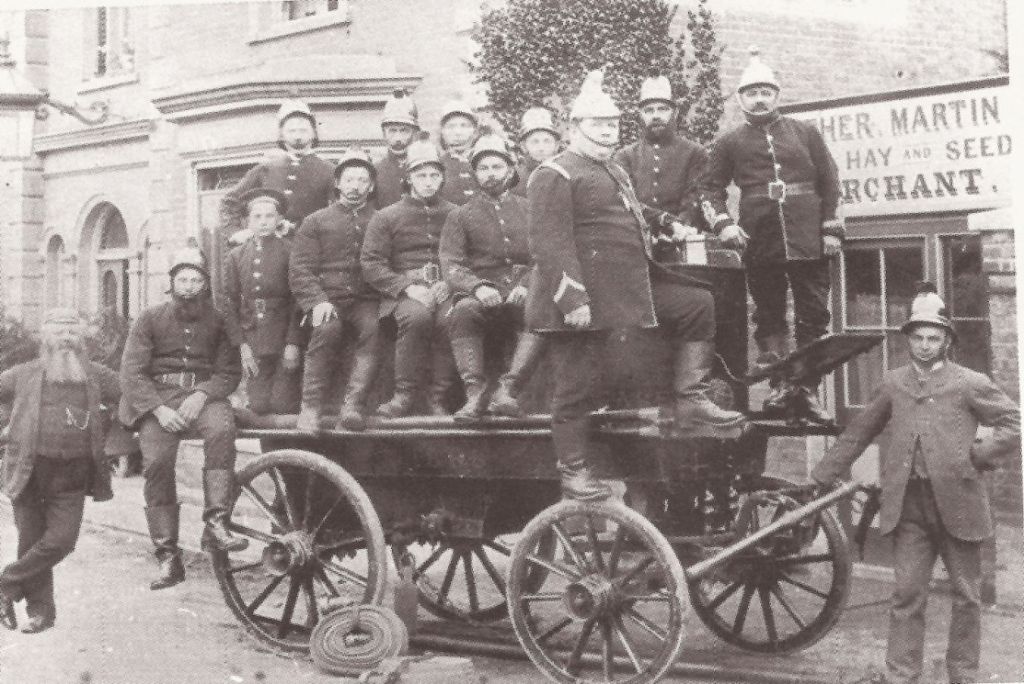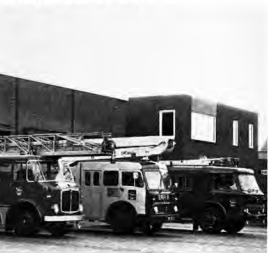
The history of East Sussex Fire & Rescue Service is typical of the way in which fire services have developed across the country. There is a great availability of history regarding firefighting in Lewes, the first mention of primitive firefighting equipment “leather buckets and iron hooks” is in the Lewes Town Book of 1576. By 1680, the Lewes had its first fire engine by all accounts an inefficient wooden contraption.
At first Town Constables were responsible for firefighting, they were not trained and were assisted by ‘volunteers’ who were press-ganged into hauling the engines to fires and firefighting., accounts state that payments made for firefighting included beer for the ‘volunteers’ and oil for the equipment. In the 1780’s two engines were purchased, one of these can be seen in Anne of Cleves House, and Lewes’ first fire station was built. Within 60 years the Lewes Fire Establishment was formed with twenty firefighters and a fire engine paid for by public subscription. This was followed by the Cliffe Volunteer Fire Brigade who had their own engine and another fire station. Lewes had two separate volunteer brigades until they merged in 1881.
In 1889, a motion to consider a paid fire service was defeated by the Borough Council. The Borough Council was subject to scathing criticism by press and public after the “Great Fire of Lewes” at Dusart’s Baths on the High Street in 1904, only the intervention of modern appliances from the Brighton Volunteer and Police Fire Brigades saved the day. After this a fire station was built in North Street and a new steam fire engine bought. The Borough Surveyor took on the duties of Chief Fire Officer and a Fire Brigade Committee was formed. By 1930, the Committee had had expanded beyond firefighting and were testing fire extinguishers and giving fire safety advice.
The Fire Brigades Act 1938 required local authorities to set up their own brigades, the Fire Authorities in our area included the Borough Councils of Bexhill, Hove, Lewes and Seaford; the Urban District Councils of Burgess Hill and Newhaven and the Rural District Councils of Battle, Chailey, Hailsham and Uckfield. Brighton, Eastbourne and Hastings had their own Fire Brigades. For the first time a government minister, the Secretary for State for Home Affairs, was given central responsibility for the fire service.
These fragmented localised services could not cope with war-time conditions and on 18 August 1941, the fire service was nationalised, becoming the National Fire Service. For the first time there was standardisation of pay, conditions of service, uniform and rank markings. The National Fire Service continued after the war until 31 March 1948.
On 1 April 1948, the Fire Services Act 1947 gave control back to local authorities, this time County and Borough Councils. The seventeen pre-war brigades in our area became four – the Borough Brigades of Brighton, Eastbourne and Hastings and, for the first time, East Sussex County Council Fire Brigade.
The Local Government Act 1974 merged the four brigades in to one East Sussex County Fire Brigade. Since 1997 East Sussex Fire & Rescue Service has been managed by East Sussex Fire Authority.
The Firefighters Memorial Trust Firefighters Memorial Day
East Sussex Fire and Rescue Service is committed to supporting the Firefighters Memorial Trust’s Annual Firefighters Memorial Day.
Read more about the Memorial Day and East Sussex Fire and Rescue Services Roll of Honour
Timeline
Thanks to former Chief Fire Officer Peter Rogers who provided this timeline of the formation of East Sussex Fire and Rescue Service
On 31st March 1974 the following was the situation-
- Brighton. CFO Frank Furlong DCFO Percy [Les] Ellis
- Eastbourne. CFO Frank Tarling.DCFO Albert Green
- Hastings. CFO Reginald Beaumont.DCFO Bernard Mallion.
- East Sussex. CFO Eric Whitaker.DCFO Dennis Robins.
1st. April 1974.
- New East Sussex. CFO Eric Whitaker. DCFO Dennis Robins. ACFO Percy [Les] Ellis
- Divisional Commander A Div Robert Clarke
- Divisional Commander B Div.Reginald Beaumont.
The following are the combined annual statistics of the four brigades at the time of the amalgamation. - Personnel – Wholetime,388. Part time,417.
- Major Appliances – 67
- Total Calls – 6577
Total cost-just a smidgen short of £1 million
A memory from 1 April 1974

At the time of reorganisation I [Tom Brown] was the proud Station Commander at Lewes Fire Station, East Sussex Fire Brigade.
Early in the night of 31 March 1974 I attended an RTA (as they were then known) on the A23 north of Brighton at Newtimber. Watertender Hurstpierpoint (East Sussex) and Rescue Tender (Brighton County Borough) attended.
A car had ploughed into the central Armco barrier and its horizontal support, a bit like a scaffold pole, had gone right through the engine compartment and the driver’s thigh.
Using (probably) a Cengar saw the crews separated the casualty from the rest of the Arnco when, leaving the poor guy, with a length of the pole still in his thigh, in the hands of the ambulance crew, one of our team suddenly remarked that it was dead on midnight, now 1 April when reorganisation took place.
The Brighton RT now became East Sussex Fire Brigade, the Hurstpierpoint WrT changed from ESFB to West Sussex Fire Brigade, whilst I remained East Sussex. We all gleefully shook hands wishing each other well for the future whilst the ambulance took the poor bloke off to the Sussex County Hospital!
Ex Firefighter Geoff Wicks
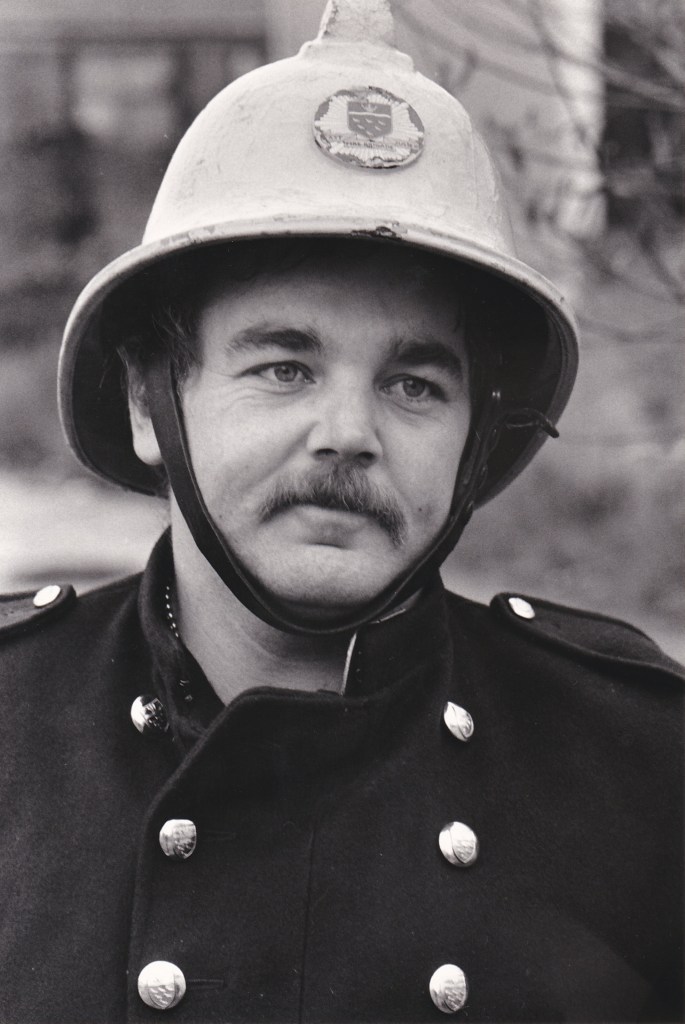
Geoff gives a snapshot of some key events during his time with East Sussex Fire and Rescue Service.
- Ff. Geoff Wicks 1166 Stn. A4, Preston Circus Brighton.
- Joined ESFB on 10th November 1975…. Retired on 31st March 2016.
- All 40 years 4 months and 22 days operational. Originally starting on White watch at Preston Circus.
- Then onto the original Green watch a year or so after the 1977 strike until retirement.
Starting with a three watch system (Red, White and Blue) of 3 days, 3 nights followed by 3 days off (48hr week Average) with a rota X. (A full tour over 6 days was 72hrs!) 23 personnel on each Watch.
Nearly every Firefighter in 1975 on White were ex Borough and did not have much time for ESFB changes. The best bit I believe was the ex borough guys managed to negotiate a nice annual Christmas bonus.
I remember being given yellow split leggings which were held up with dog clips attached to your waist belt. (Not the thin black plastic elasticated ESFB ones)
A summer lightweight Brighton tunic, complete with Brighton Borough buttons. Then being told to go to Surrey Street Army & Navy surplus store to purchase original used leather fire boots which we took to the shoe repair shop off Seven Dials to have replacement rubber commando soles put on. (Not to bother wearing the steel toe capped, very uncomfortable rubber wellies I was issued! Unless it was for a chemical incident of course!)
They were all very proud to be Brighton Borough Fire Fighters. I was also very proud to work with them all.
Preston Circus was a 3 pump station with PE, Wrt1 and Wrt2, TL, Rescue Tender and L4P.
Short wheel based Dennis fire appliances especially made for the small Brighton roads. Ordered by the Borough Chief Calvert, I believe. All having either a Rolls Royce or Jag engines with crash gear boxes. Double declutching up and down every time!!! Great fun to drive. Also all having 999 registration plates
Epco hydraulic ram system (remember the “slip lock extension” for us oldies!!) Compressed air tools including the Cengar saw and Zip gun were our main RTA cutting gear. Proving very inadequate at the Sweet Hill rail crash!!!!
A 50’ wheeled escape ladder which was a fantastic ladder to use. At a push on level ground it could be pitched by 2 Firefighters. Replaced by the 464 (Ladder with sticks!!) Putting black boot polish onto the escapes wheel rims as part of the daily cleaning/hand over routine.
A brass No.0 foam branch!!! The only time I ever saw this used was at an Uncle Sams burger bar in London Road. The fat fryer caught light and this was used to great effect. The best part was that this was September/Octoberish 1977, a little bit before our 9 week strike. Every single night during the strike they delivered free of charge burgers and chips for everyone on picket duty…. and extra very very hot chilly sauce, fantastic.
White Watch1975:- Fred Bishop, Dickie Dickson, Brian “Pongo” Purvis, Chris Windham, Doug Moody, Mick Poole, Ted “The red” Dacey, Derek Stevens, Derek Standen, Mick Everett, Bert Milner, Steve Hill, Taff Jones, Chris Allen, Charlie Humphries (Last Borough Ff), Budgie Hurst, Mick Wallis, Gordon Gledson, Brian Whittaker, Andy Sakowski, Jim Uwins, Mick Collins and Geoff Wicks.
Loads of great memories and would do it all again if I could.